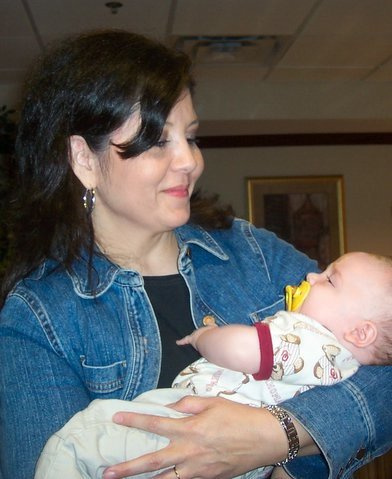
Thursday, September 21, 2006

Lisa update September 21, 2006

Hey gang, you'll have little difficulty figuring out from the ugly appearance of this post that this is richard, unaided by my dad's purtifying efforts, here to give you the mostly positive news from today.

Dr. Kwasnica confirmed today that the worsening of Lisa's spasticity has stopped since she's begun the new mix of meds in her pump and that she's showing definite signs of improvement in the rigidity that has plagued her, not enough yet to get her back to actively participate in therapy but at least heading in the right direction.

The fear I expressed to you all earlier this week about Lisa being prematurely discharged appears to have been resolved as a result of Dr. Kwasnica hitting a trifecta for Lisa today by getting the adminicrats, the insurance company and the other doctors on the same page for Lisa's treatment plan. Lisa will remain in neuro rehab while her current medical issues resolve (she's quickly beating back another infection under the careful care of our favorite bug doc, Dr. Kume) and continue here until Dr Kwasnica is satisfied she's getting the pump mix to an optimal level for Lisa. Next, Lisa will remain in BNI while she completes enough of the hyperbaric treatments to get an idea if they're going to help, 20 to 40 sessions probably 3-6 weeks. Again, this assumes Dr. Fracica is successful in obtaining approval from St. Joe's internal review board for the hyperbaric as I discussed earlier in the week.

Dr. Kwasnica has also continued to consult with other colleagues for other treatments to help Lisa. Dr. Kwasnica has told me that Lisa's downturn is the result of the profound injury she's suffered. One possible contributing factor in that injury may be a slight increase in pressure in her brain caused by fluid replacing the space left by dead cells her body has discarded. Scans show any increase is small but possibly enough that if relieved might lead to an improvement. Dr. Theodore, the neuro surgeon who implanted Lisa's pump, will be briefing me in on this in more detail and on treatment strategies to relieve pressure if it's found. Dr. Kwasnica advises that this condition is common in serious brain injury cases and medical research shows that successful treatment can bring improvement in the patient. I'll keep you posted.

Dr. Kwasnica spent 45 minutes with blue cross's medical director, an old colleague of dr. k's, bringing him up to speed on Lisa's condition and progress and pressing him to do the right thing on covering the cost of the hyperbaric. While he's reserving judgment on that he agreed that Lisa needs to stay under dr. k's care till we've had a chance to get her medically stable and work through these anti-spasticity strategies. Everyone is now in agreement that if Lisa does respond to this game plan and can take advantage of the rehab crew at BNI that we'll gladly jump back to the beginning and put her to work.

We'll also begin serious discussions and planning if Lisa doesn't respond to these therapies. As I mentioned earlier in the week, the neuro rehab staff will help us plan home modifications and training to care for Lisa while she continues her recovery, whether that's in another rehab facility without the acute medical care Lisa won't need or here at home. Some have suggested I consider looking at insurance options other than my liquor store robbery plan, and, in the interest of keeping my options open, I'm prepared to include this in my ever-expanding list of things to do.

For those who've been spoiled by your regular reporter/editor, Dad is driving back to Illinois; Sherry is flying with Michael where they'll close on the sale of their home of the last 25 plus years so that they can make the permanent move to Tucson to help with Michael and Lisa after she's ready to come home. They've also abandoned their intended retirement plan of driving their recently purchased motor home (think aircraft carrier) around the country; it's going up for sale when they get back. Dad and Sherry have purchased a small but cool place that is being built nearby that'll be ready in November so the sale of the Illinois home is just in the nick of time.

I don't have good words to describe their good works. I appreciate all the kind things folks say about what I'm doing, but I've gotten the benefit of being chosen by the best person I've ever known to be her husband and the father of her child. I have to do these things because I'm the only one who can make the decisions Lisa's choosing me means I have to make. But, for me to do anything for Lisa, I have to have….time, time to meet and talk with doctors, nurses, therapists, nurses aides, family members of other folks with Lisa's type of genetic condition and injury, insurance folks and laboratory representatives to gather information, seek advice, form opinions and strategies and then implement them. I have to have time to read medical journals and other publications that help me understand what'll help and what the heck these docs are talking about. I have to have time to do these things and the other stuff only I can do- work, pay bills and spend the time a husband and father gets to spend with his wife and son to be a family, even if it's in a neuro rehab room. This simply doesn't leave time for a lot else. The family and friends who've put aside their own time-consuming agendas, needs, opinions and judgments and chosen to simply ask me "what can we do to help?" and then done exactly what they promised are the real heroes for Lisa and Michael.

So, thanks to all who are helping me help Lisa! r

Monday, September 18, 2006

LISA TODAY – SEPTEMBER 17, 2006

Barrow Nurological Institute – Phoenix, Arizona

Hey gang, Richard here from Lisa's room on Sunday evening. It's been an eventful several days for us with some good and some not so good stuff. But in keeping with our practice of laying it all out there, here's the latest:


The good: Lisa's team is slowly resolving the difficult task of balancing her needs for nutrition, digestion (and all that …entails) and therapy. The result is that she isn't having therapy interrupted by accidents that rob her of valuable therapy time. I could see proof of the improvement in doing her laundry last night. The last several weeks have just been a mess, but this week it was just laundry. By the way, thanks to Melody, Karen and CJ for giving me the idea (really, permission) to roll her therapy pants rather than fold them during their visit last weekend, it really helps keep her shelf neat and organized.

Also good: as soon as Lisa finished her course of antibiotics last week, Dr. Kwasnica started her on a new mix of medicine in her pump. As frequent readers will recall, Lisa has a pump implanted in her abdomen which bathes her spinal cavity (the intrathecal space) with medicine. Until now, that medicine has been Baclofen, the leading drug for controlling spasticity. Because of its side effects (drowsiness, constipation) when taken orally, the pump gets the medicine where it needs to go with much smaller doses, hence much less of a problem with side effects. The new medicine, Klonopin, also has a proven track record of helping with spasticity and Dr. K's hope is that the two together will work better than either alone.

After just a few days, Lisa's therapists are reporting the steady rise in rigidity has stopped and Lisa's muscles seem more relaxed. The facial contortions Lisa had been making have pretty much disappeared and she's clearly resting better. Still, it's too soon to tell much, but hopefully the flood has crested. Dr. K is pleased but is taking it easy in increasing the dose so she can make sure Lisa's blood pressure stays up where it needs to be. She believes over the next 2-3 weeks we'll be able to see where the new mix will take us.

Lisa also received a consult from Dr. Holly Shill, dad her mentioned last week. After sharing her opinion that Lisa's muscle rigidity is coming from spasticity not dystonia, I asked if she had other suggestions on helping Lisa. Dr. Shill offered to go back and take another look at Lisa and, after visiting with Dr. Kwasnica, she gave Lisa several Botox injections intended to help relieve the stiffness in her neck that causes her to tilt her head to the left. It will take about a week to see the effect, so stay tuned and we'll keep you posted.

Even more good: as each of the "tried and true" therapies have come up short, more experimental ones become more attractive. Chief among these is hyperbaric, as dad described in the last update, treating anoxic injury and spasticity with pure oxygen saturating the body under pressure is proving for some to be helpful. Because it is experimental, insurance coverage is something we won't know about till after the course of treatment and St. Joseph's won't let us use their chamber without jumping thru hoops. The first was (big surprise) money. Because, Blue Cross won't pre-approve experimental treatments, the hospital is requiring us to pre-pay in order to make sure they don't get stiffed. Fine! Blue Cross has been (I am not kidding) wonderful for us. They've been honest, responsive and fair from the get-go. When we needed to get Lisa on the helicopter to get to Phoenix's Arizona Burn Center to save her life from the Stevens-Johnson syndrome, they told me to just go and we'd work it out- and we did. When they told me they couldn't pre-approve experimental genetic testing to determine if Lisa had the genetic condition that would explain her (and her father's) sudden cardiac arrest, but they'd review the claim for "medical necessity" and would be fair, they did and were. So, while I'm not sure how much we're going to have to pre-pay (and thus how many liquor store robberies I'll have to pull) I trust Blue Cross to be fair. In any event, Lisa's going to get the opportunity to benefit from hyperbaric, regardless of who pays; I just want it to be here where we can evaluate its results with her gnarly crew of therapists, so on to the next hoop.

Once the money issue is (kind of) resolved, we have to get the support of Lisa's doc, Dr. Kwasnica and the pulmonologist who runs the hyperbaric program Dr. Phil Fracica. I met with him on Friday, though we'd talked earlier in the week. He'd given me a 200 plus page homework assignment- the federal government's review of the evidence supporting hyperbaric for different types of brain injury. I'd read summaries of it and other research, but Dr. Fracica (pronounced fraSEEKa), wanted to make sure I was clear on how unclear the literature is on the benefits for Lisa's type of injury. The bottom line is that this wouldn't be our first option, but it can't hurt Lisa and it has definitely helped some folks. Once he was convinced my expectations were in line with the research and that I wasn't going to rob a bank to pay for it (he didn't ask about liquor stores) he told me he'd support our application to the (next hoop coming) the St. Joseph's internal review board.

The internal review board must approve experimental uses of the hospitals stuff which this would be. They meet every two or three weeks so hopefully, with the money thing cleared and doctor's support, we'll soon get a green light.

So what's the not-so-good news? Well, attending my meeting with Dr. Fracica was an administrative person, who was interpreting Dr. Fracica and Kwasnica's opinions to support her conclusion that Lisa would need to be discharged in 2-3 weeks! Don't get me wrong, we love these folks and they've made us feel at home, but we want to leave here not live here. Still, the deal we have is that Lisa will get the opportunity to benefit from available treatments and therapies to break through her spasticity and to begin rehabilitation in earnest. Plan A (Baclofen pump at 700-900 micrograms per day) didn't work, so we're on to plans B and C. If they don't work, I'm not giving up but I'm not expecting Barrow Neurological Institute (BNI) to try herbal remedies and acupuncture. If they do work, then I expect us to get to work with the staff as we had planned before the spasticity kidnapped Lisa's recovery. So, we'll begin discharge planning, outlining home modifications, etc, but for the next couple of months I intend for us to be here working to break the grip spasticity has on Lisa.

I simply can't let "adminocrats" or anyone else keep Lisa from getting the best chance for the best recovery she can make. I am surer than ever that we have the best doctors, nurses, rehab techs and therapists in the world working to this end. Lisa has the support of her rangers who visit every day; Yolanda, our friend from select who now provides the skilled range of motions exercises during the week and Michael the archangel who looks more like his mother everyday and spends the weekends making certain I, along with everyone else here is taking every effort to get his mom home well.


I am here in Lisa's room, it is a little past 9 p.m., and she and Michael are sound asleep. I'm thinking of those working here at BNI have a big week ahead of them—as do we all. Please continue to keep us in your prayers and thoughts, including Sherry, whose help with Michael and running our house has made my efforts possible. Her recovery from the angioplasty and stint has been remarkable but not easy. Also, Maggie the wonder dog, holding her own against lymphoma, so she can still be Lisa's favorite girlfriend. I didn't know dogs got cancer, had their own oncologists and respond so well to chemotherapy but now I do. The treatments aren't a cure but can, and are, buying time and quality time at that, so please send a kind thought--a good dog's way. r

Posted for Richard

(Picture is of Yolanda with Michael)

Michael

mlwintory@msn.com


Wednesday, September 13, 2006

LISA TODAY - 13 SEP 2006


Lisa Anne Wintory
Today – September 13, 2006

Lisa is a patient at the Barrow Neurological Institute (BNI) in Phoenix, Arizona

Let start by telling you that try as I may, I’m having difficulty not turning this into a Soap Opera, having said that… Wednesday was indeed a big day for Lisa in that, her proxy and next of kin Richard, met with Lisa’s medical team. They were there to talk about her life and future at the BNI. The meeting on this day was less than routine, which is not what one would expect, considering the familiarity among those in attendance. Familiarity brought about by, the teams frequent one on one contact with Richard, months of similar meetings, and the unified cooperation between the participants. The room was same; arranged in the same manner, but there was unspoken tension before the meeting began. It room seemed electrified by the participant’s apparent nervousness. This meeting was all business, with bare cordialities expressed, and it started with a rifle shot. The doctor’s tone was all business when she announced the purpose of the meeting: Lisa’s medical status. And, right away stated there is a limit on the time she had for each of her patients; further there is limited time that the staff can give as well. With Lisa is losing ground to Spasticity her pain level has increased, and (consequently) she has begun tracking less with her eyes. The time consuming hold that her recovery from bronchitis took has delayed the next phase of her treatment plan. So why? Let me ask you if you have ever eaten something that didn’t agree with you or been on a medication that gave you unpleasant side effects? Maybe you got an upset stomach and were nauseated or worse. Maybe you got intestinal symptoms with cramps, difficulty going to the bathroom or the opposite of not being able to leave the bathroom. We’ve all experienced those symptoms in our lifetime. You would certainly talk to your doctor about changing your medication, changing your diet; maybe, drink more water or almost anything to avoid these symptoms. Such is the plight of Lisa in the midst of battling the spasticity. Her tub feedings must be adjusted to deal with her symptoms. Other medications are added to her course of therapy that has made it extraordinarily difficult for the physical, occupational and speech therapists to work through, and also if you can put yourself into Lisa’s place then think about how she must feel being totally unable to communicate or have the benefit to express how she is feeling.

The additional drug which was intended to accompany Lisa’s Baclofen therapy was Klonopin (clonazepam). In some patients Klonopin it is known to reduce muscles spasms or stiffness, and in combination with Baclofen may reduce Lisa’s muscle symptoms. The (hopefully) dynamic duo of Baclofen and Klonopin may be the magic bullet to knock her spasticity down. Klonopin is already in Lisa’s treatment plan, and it is sort of old news; but what is in today’s news is that Klonopin has now being administered.

Richard has had discussions with Dr. Kwasnica and others at Barrow Neurological Institute (BNI) about using BNI’s hyperbaric chamber as part of Lisa’s therapy. The chamber is managed by another department in the hospital, and is under the direction of another physician. The hospital also has an internal review board that must approve the chamber in Lisa’s case. There is antidotal evidence that suggest the hyperbaric chamber can be useful to Lisa’s well being. The F.D.A. has not approved the chamber and therefore its status remains experimental. The hospital wants prior approval from Blue Cross/Blue Shield that they will pay for Lisa to receive hyperbaric treatments. So for two or more months there have been many conversations between Richard and BNI physicians, and administrators to get it approved. Finally to break the stalemate, Richard offered to pre-pay the cost for the therapy, and asked, “Who do I make the check out to?” “We’ll get back to you on that this Friday,” someone said. The problem again is that the treatment is considered experimental because its effectiveness has not been proven; however, there are recorded cases where it has provided relief in cases like Lisa’s and Richard told the doctors I want her to have the opportunity, every opportunity to get relief from Spasticity.

The theory is that hyperbaric therapy helps oxygenate the brain, and might help to revive some of Lisa’s neurons that may be only “stunned or injured.” With hyperbaric, oxygen can get through the blood brain barrier to reach parts of the body that do not have good blood flow. So, the therapy might fire up idling neurons, or neurons which are not dead. With a bit of luck, Lisa’s rigid muscles will relax through the brain regaining its ability to tell Lisa’s muscles to “lighten up.”

There are BLOGS and Bulletin Boards on the Internet which provide information about anoxic injuries. Richard has been interacting with some of the authors of these web sites who have reported on their own or a close family member’s story. It has given him great insight into Lisa’s situation, and enabled him to talk with people whose own loved-ones have benefited from hyperbaric treatments.

Finally, it is agreed by all concerned that hyperbaric therapy can do no harm, and the reluctance of the BNI hyperbaric department to proceed is that it, “may not be effective.”
Last week Lisa was evaluated by Dr. Schill who is an expert in the diagnosis of dystonia, and a condition that she was suspected of having. Dr. Schill reported to Dr. Kwasnica that in fact Lisa does not suffer from dystonia. So that closes the chapter on that.
In concluding the meeting on Wednesday, we learned that for now, Lisa will remain at BNI that the staff is wanting more progress, but then don’t we all.

Last Friday Melody Nelson, her sister Karen Mitchell and CJ Murphy all from Norman and or Oklahoma City flew to Phoenix and Lisa for a “Girls Weekend.” And what a weekend it was, Karen, who has a gift for interior design took a picture of Colin and Rylee Goodspeed and their cousin Michael and had it blown up to poster size; then she got a St. Joseph’s maintenance man to stick it on the ceiling right over Lisa’s bed. So every time Lisa looks up she has a living color, life size portrait of her three favorite people, baby Michael and his cousins Colin and Rylee. C.J., Melody and Karen also rearranged the decorations in Lisa’s room, and scolded Richard on the lousy clothes folding he’d been doing, then praised him for the excellent wardrobe he assembled for Lisa. Then, Melody exchanged baby Michael for Richard, and sent Richard packing; so around midnight Friday, Richard arrived home and when he woke, he fired up his Oklahoma Smoker and started working on pork shoulders, brisket and roasting hens. If you have not smelled pecan wood smoke, and/or tasted the results, let me be the first to tell you that it is a sure ticket to start your saliva glands working overtime. It smells great, but not a great as the final product. Richard delivered a wonderful feast to the on-duty staff at BNI on Sunday, and better still Sunday late afternoon he got to introduce all of Lisa’s Rangers to Melody, Karen and C.J., as they got to enjoy Richard’s wonderful meal. Lisa’s Rangers are at Lisa’s bedside every Monday through Thursday: Sandy Janzen is there Monday, and Bruce Bower and his wife Laura Recker are with Lisa on Tuesday’s. (It was Laura who we went to Mass with in June.) On Wednesday’s it’s Suzanne Cohen and Bill, and then on Thursday Ken Vick and Vince Goddard are there.

This part is about Lisa’s dog Maggie. Maggie is eleven, and was being treated for a heart condition by a local vet. I noticed that a cough she had was becoming persistent so the vet examined her and subsequently diagnosed her with lymphoma. Richard then had another decision to make, and he chose Life. Life for Maggie. He asked me to take her to a veterinary oncologist, and there Dr. Klein prescribed chemotherapy that, I must tell you, Maggie is responding well to. She has maintained her weight, and her hair (in case you were wondering), and I think she believes the peanut butter I hide her medicine in is a treat to be enjoyed 2-times a day. And, yes our Scotties, Mac and Tosh get in on the peanut butter too.
Sherry took the opportunity to visit her Mother Beverly in E. Hampton, Connecticut. Her nephew Josh was getting married and she and Kris her daughter from Decatur, Illinois went to the wedding also. On the return flight through Dallas/Fort Worth, she experienced “exertion chest pain” from rushing through the terminal. It chest pain reemerged at the Tucson Airport. A heart stress test was scheduled, which as you might expect she failed; so an angioplasty was scheduled at Tucson Medical Center. A coronary artery was discovered to need a stint, and after it was applied she was good to go. A follow-up stress test is scheduled for 15 Sep, but she feels just wonderful. I expect her to pass this go-around with flying colors.
We received the good news that our house in Illinois has found new owners. Sherry and Michael are flying back September 22nd. I will drive so can bring Mac and Tosh (the two Scottish Terriers) with me. There is some unfinished business that Mac & Tosh want to take care of, namely a taunting Fox Squirrel, and a stray cat or two that wander across the back yard fence. It will be a fun drive back to Illinois. In case I have not told you, our new Arizona home is being constructed for us on Dove Mountain in Marana, Arizona. We purchased a residence at Heritage Highland Gateway at 5358 West Arid Canyon Drive, Mariana, AZ 85653-4067. It is an “active adult community” with many of the amenities Sherry was looking for. We expect it will be ready for us not-later-than the end of November. We’ll be 9.5 miles from Richard and Lisa’s residence.
I used to work for a gentleman, Jack Ennis, in Galesburg. Jack used to tell his employees, “just because you found a job, don’t stop looking for work.” Jack’s humorous expression comes to mind when we recently went shopping for furniture and appliances. It’s not like we haven’t enough to do.

Warmest Regards from Arizona,

Michael
mlwintory@msn.com

Tuesday, September 05, 2006

LISA TODAY – 5 SEP 2006


Richard and Lisa, were married October 9, 2004 at the Hilton resort hotel in Oro Valley, Arizona. Together, while holding hands and peering into each other’s eyes they solemnly said to each other, and before family and friends, “…in sickness and in health…” Richard would say later, “we were all about that… commitment.” No one there, least of all Richard and Lisa realized the test that was in their future. The drive from Tucson to Phoenix, and Lisa’s bedside takes a few minutes less than 2-hours. For Richard and baby Michael the drive has become a ritual that these two faithfully engage in on Fridays. This past Friday, they found Lisa resting comfortably. It was good to see her regaining some stability from the recent problems she encountered with bronchitis.

Lisa’s therapist resumed working on range of motion and it is a deliberately slow process as the faster her limbs are moved the more severe her tone becomes and the reverse is true; very slow motion the pain is less. It is the nature of Spasticity.

Lisa’s mind is also being exercised it is done with photographs of Michael and Richard being moved around the room so that Lisa can track them with her eyes.

I reported to you that a new drug was going to be given to Lisa in addition to the Baclofen to combat the Spasticity. It has not yet been administered because of the pneumonia and bronchitis Lisa needed to overcome. So, I’ll tell you more about this as it develop.

Wednesday is a big day for Lisa. Her medical team will meet with Richard to strategize Lisa’s treatment plan. Job One is to break the hold Spasticity has on her. We know Lisa is alert and aware, but unable to communicate--unable because of Spasticity, and more about the meeting later.

Michael mlwintory@msn.com

(The two pictures: Lisa and Richard on their wedding day and Lisa with Maggie who is now 11.)

Sunday, August 13, 2006

Lisa Today - August 13, 2006

Hello everyone, Richard here from Lisa’s temporary room on one of the “telly” units here at St. Joe’s. Lisa will be back in her room at BNI’S neuro rehab tomorrow (Monday) morning with an old ally –her trach- protecting her from opportunistic infections that would delay her recovery.

Lisa’s continuing struggle with spasticity developed a new complication that called upon the many medical resources here at St. Joe’s. With Lisa’s muscles so rigid, pain and medicine for that pain necessarily follow. Despite the efforts of Lisa’s caregivers, her bowels became impacted, most likely from the pain medicine, resulting in nausea and vomiting on a couple of occasions. Lisa inhaled or aspirated during one of those episodes, drawing the bacteria- laden material into her lungs.

With her spasticity also preventing Lisa from protecting her airway, her caregivers were ready to respond to the next threat, infection. Lisa’s pulmonologist, Dr. Wright, and her regular guardian angels, Dr’s Bliss and Kwasnica, recommended Lisa get her trach back. They explained this will make keeping her lungs clear from secretions (like those caused by allergies) or other aspirated material safer, easier and free from the trauma of having to run a tube up her nose, down her throat, past her voice box before reaching her lungs. This was done without a hitch on Thursday.

Next, the team was ready for the inevitable infection from the aspiration with powerful antibiotics targeting the specific bugs before they had a chance to do damage. To manage the process, Lisa’s doc’s moved her to an ICU bed where her condition could be closely monitored.

The ICU staff was really wonderful and welcomed us with warm compassion and clinical expertise. Normal restrictions were waived and I was permitted to be with Lisa overnite in her tiny, equipment jammed room. Michael won rave reviews when I taped up pictures (he couldn’t come into ICU) from his recent visit with his Oklahoma relatives and Godparents Jack and Napua.

Dr. Kwasnica kept Lisa’s neuro rehab room for her so we didn’t have to pack and unpack; a huge blessing for the organizationally challenged.

By Saturday, Lisa’s infection was under control, her numbers were all good and she was ready to move out of ICU and into a unit where she could be monitored (with telemetry, hence the nickname “telly”) until Monday morning when neuro rehab opens again for admissions.

As pulmonologist Dr. Wright says, “No more rehab days lost to preventable stuff.”

What’s next? We jump back into our fight with her spasticity. Lisa’s Baclofin pump is above the level we hoped would provide relief with her muscle tone improved but not enough to permit her to begin rehab in earnest. So, with Plan A not “gettin’ r done” Lisa’s team is putting together Plan B.

We’ll keep you posted, but be certain; the folks on Lisa’s team are caring for a lot of other folks in need. So, I am absolutely committed that 100% of the time that Lisa’s team has to work at getting Lisa better will be spent on that and that alone. I’m grateful for the understanding that nothing must distract or delay getting Lisa past this obstacle and firmly on the road to rehab. So, I look forward to answering (or getting answers to) any questions about Lisa’s care and conditions from all the many who love her too.

I know Lisa’s ready to get back to work in rehab when we find the right mix of medicine and therapy, whether it’s inside the box or outside of it. Helping find and fund that right mix is my Job #1 so, please keep us in your thoughts and prayers. Richard. wintoryok@hotmail.com

Saturday, August 05, 2006

LISA TODAY – 05 AUGUST 2006

Two Happy Guys

It was a happy reunion for his Uncle David, shown here with his nephew Michael as they recently got together for a brief family gathering in Oklahoma City. Auntie Suzanne, and his Cousins, Colin and Riley were there too to get in on the fun. It was more than nice as Godparents Jack and Napua Davis made the arragements and provided sumptious refreshments for us all.

What is more fun that a pile of kids jumbled up on a bed?(L to R) Riley, Colin and Michael would say: "NOTHING!"

What's New...
Lisa finally has reached the 1,000 Microgram dose of Baclofen which is ever-so-slowly and carefully being administered. The dose is now at the level Dr. Kwasnica expects Lisa's Spasticity will loosen its grip on Lisa. She recently has become noticeably more alert and regained her ability to respond with "good eye blinks." noticeably
Richard has become a studious hospital fashion buyer. Talking with hospital staff and others, he has learned that, for patient Lisa, a sports bra and stretchy bike pants are most comfortable. This rules out "shorts" as this type of garment tends to creep, and you know we all hate that, do we not?
Speaking of cloths, it may have occurred to you that someone must launder her personal clothing, you may even have wondered, who or how does it get done? Suzanne Cohen, who ranges Lisa on Wednesdays has also stepped up and taken on this additional task. Now I don't want to shock you, so step back-get a drink and, well listen to this: Richard does Lisa's laundry on weekends. In fact, he has become a "Tide" maven--even separates the colored items from the whites--folds them right out of the dryer, and even... talks the talk with others about laundry stuff. What's next for the wonder boy? Ironing? Yeah, as if!

This is a picture of Trent. Trent is Lisa's Occupational Therapist.... Great Guy!

Meet Tom! He is Lisa's Physical Therapist, and is shown here with one of Lisa's $4,000 ankle splints. It's made just for Lisa.

Sherry, Michael and I will drive up to Phoenix this afternoon to see Lisa and Richard.

Till next time...

Michael - mlwintory@msn.com

Saturday, July 22, 2006

LISA TODAY - 23 JULY 2006

How’s Lisa doing? July 19, 2006


I wish I could find the words to describe for you the skill, commitment and compassion of the “purple team” working to give Lisa the best chance to make the best recovery she can. While I’ve met with each of Lisa’s team members individually, and they meet each week to staff all their cases once a week, today, July 19, 2006, was the first time the whole gang gathered to discuss where we’ve been and where we’re going.

As I mentioned in my last, very wordy, update, by the last week in June, Lisa’s body and progress had been locked in the grip of Spasticity. Lisa’s ankles had turned almost completely over, her chin is thrust forward and upward and pulls to her left shoulder. She’d lost many of the hard-won gains she’d made including her ability to nod and blink answers to questions, shift her weight in the standing frame and move her arms and legs slightly but freely.

Lisa’s team, (each of the rehab teams is identified by color, Lisa’s is purple) beginning on Monday, June 26, launched a full-scale assault on this enemy. The attack has 4 elements: increase her Baclofin amounts, use Botox on her most vulnerable joints and with the gains made possible by the Baclofin/Botox, use a series of casts to get Lisa, literally, back on her feet. Aggressive range of motion exercises and stretching both protect her from crippling contractures of muscle and bone as well as measure and extend the progress Lisa is making as Baclofin slowly melts the icy grip of Spasticity.

Because nothing in Lisa’s recovery is simple, the efforts of her team have been hampered by a problem that has plagued Lisa most of her life: allergies, secretion-causing allergies. The secretions collect in the bottom of her throat, and Lisa, unable to clear her throat due to the Spasticity, must work harder to breath. Her team consults with respiratory therapists. They help with supplemental oxygen when Lisa needs it, breathing treatments and removing the secretions by suction. A pulmonologist, Dr. Wright “bonks” some of the secretions Lisa inhaled into her lung and than assures Dr. Kwasnica that none of this should interfere with the teams’ continued assault on Lisa’s Spasticity, indeed, the sooner Lisa can protect her airway, the better.

With this green light illuminating the team meeting, each of Lisa’s “purple” therapists, reports. All detail how Lisa is slowly regaining ground lost to her stiff muscle tone. Each says that Lisa is beginning to blink answers again, is becoming more responsive and is able to-for brief moments in therapy- more freely move her jaw, arms, neck, and legs. Still the key word is “slowly”. Lisa’s overall condition is tight, each movement of each and every muscle requires varying degrees of pressure and causes an equal amount of discomfort.

Dr. Kwasnica decides after speaking with dr. Wright, to cautiously press on with Baclofin increases up to 700 micrograms a day (mg/d) - a tiny amount if administered orally, but when contained within the intrathecal cavity containing Lisa’s spinal cord, a pretty healthy amount. Dr Kwasnica believes Lisa’s will require between 700-900 mg/d to control her Spasticity, so the idea will be to see how Lisa’s system responds to this amount before increasing it again. The goal? Loosen the grip of uncontrolled muscle stiffness without impairing Lisa’s ability to control when she wants to stiffen her muscles as when she wants to move her limbs.

Next, the team discusses new therapies and a decision is made to get Lisa back into an environment in which she thrives- the pool. Hydrotherapy is still classified as an “alternative” to traditional treatments, but one the team believes will benefit Lisa. There are logistics to be worked through but I’ve got her swimsuit ready and so, the following day Lisa’s back in the water. Freeing Lisa from the full effects of gravity makes it easier for her to move against her tight muscles. The session is declared a success and so will be the first of many.

Another alternative treatment- hyperbaric oxygen therapy (hbot)- is also kicked around. The idea is to place the patient into a pressure chamber filled with pure oxygen and increase the pressure anywhere from 1.5 to 2 atmospheres, about what you’d experience at 33 feet underwater. Treatments last an hour and are done a couple of times a day for as much as a month. HBOT is still considered experimental for Lisa’s type of injury but there are very promising results that have been obtained in individual cases. Dr Kwasnica, ever the optimistic skeptic, is reviewing the literature and consulting the handful of docs around the country doing what she does, to see if this is right for Lisa.

More about that last point: Christina Kwasnica, MD. is, officially speaking, a big dog. She doesn’t act like it (quick story- Michael and I stay with Lisa on the weekends. I try and feed him, take my shower and get dressed before the dayshift activities get started, usually by 6 am. The shower for our room is shared with the adjacent room so while you’re in there every sound carries. Michael will, especially when happy, make quite a bit of noise, so I’ve learned to try and shower while he’s sleeping off his first bottle to keep from waking the patient in the next room. One morning I turn off the water and hear Michael caterwauling in his crib. I panic but can’t go barging into “our” room without more on than I have at that instant. By the time I’ve dried and thrown clothes on, Michael’s quieted down. Relaxed myself now, I causally open the door to find… the program director for the world famous Barrow Neurological Rehabilitation Unit playing nanny to her patient’s son, rocking him in her arms back to sleep. Maybe this wasn’t a quick story still it’s illustrative of the point.) but she’s definitely a big dog within the fraternity (sorority?) of rehab docs. So, when dr. k say’s she’s consulting with her colleagues around the country about Lisa’s case it means we’re getting the best thoughts of the best minds in neuro-rehab in the country.

The next topic in the team meeting is Lisa’s morale. While possible problems with being aggressive with her treatment must be considered they must also be weighed against the certain problems of Lisa continuing to remain locked down by her Spasticity, chief among these is the certain frustration Lisa must feel. Keeping Lisa focused on her rehab requires constant and just as important, consistent confidence-maintaining support. The different sources of distraction and distress are discussed and strategies on how to avoid them are agreed upon.
Our goal is to establish a predictable routine, safe emotionally and physically, so that Lisa knows what to expect and what’s expected of her in her therapy sessions and is able to bring her full attention and efforts to bear on her rehab. The meeting ends with everyone on Lisa’s team clear on purpose, strategy and tactics.

It’s now Saturday, July 22, 2006. Lisa slept really well last night after secretions that had accumulated at the base of her throat were suctioned. She was so relaxed that she didn’t need the splints she normally wears at night to keep her arm straight or pain meds.

After working through all the more dire explanations for the secretions in Lisa’s throat, her docs are prepared to consider and treat her for post-nasal drip caused by her allergies. Medicines that we have at home, Claritin, Afrin and Flonase are ordered and with luck we’ll get her through this season with a minimum of discomfort.

I’ve got Lisa’s day splints on including her new ankle/foot splint for her right foot. The one for her left is still being tweaked by Sam the splint guy. Remember Reece the Zen serial caster from my last update? Sam must have gone to the same dojo the way he’s working over these custom-made splints to put just the right amount of pressure to protect the gains won with the casts without causing blisters or other skin breakdowns. Lisa’s physical therapist Tom wants Lisa wearing these 8 hours during the day and has walked me through how to put them on, check and remove them over the weekend. But for now I’ve just got one foot to splint and the other to stretch.

Lisa’s got therapy and a shower coming today than Mass at 5pm. Saturday evening mass here at St. Joseph's has been really special for us, and we’re looking forward for the time.

If you have questions about Lisa, I’m sure others have the same ones, so just pass them back to us and we’ll share the answers with everyone. Thank all of you again for your prayers, your support and your understanding. So many of you have sent or left messages, e-mails, cards and letters with the most wonderful thoughts and concluded by saying “ you don’t need to respond, you’ve got so much happening…” and I’ve taken you up on that too many times. So please know that while each of you deserves a thank you note for each of the many kind outreaches to us, I read everyone of these sentiments to Lisa. Our little family thanks God every day for each of you and prays for the time when Lisa can thank all of you personally. r


Friday, July 14, 2006

LISA TODAY – 14 JULY 2006

“So how’s Lisa doing?” July 9, 2006

My dad’s updates have been such a blessing to all of you and to me as well. They let us all stay pretty current so that folks who visit the website or get updates directly, can, when they bump into or call me, just hear the latest to be up to speed. But dad thought aL more comprehensive review of where we are, how we got here and what we believe the future holds from my point of view would be helpful. Also, I wanted to open a q and a dialogue for folks to ask follow-up questions without worrying about how many others have asked the same thing. Our goal is to keep those who care, are offering prayers and support and are reluctant to “be a bother” to be as informed about how Lisa’s doing as if they were here.

At this moment, 12:05 pm on Sunday July 9, 2006, Lisa’s down the hall getting a shower with Kesha and Andrew. Michael is hanging here with me deciding –ooops Lisa’s back.

Ok, it’s 1:22. We’ve gotten Lisa dried, lotion applied, her hair brushed and positioned her using pillows and weights to try and push back from her becoming the pretzel the injured parts of her brain are trying to make her into. The process was delayed by Michael insisting on attention, formula and finally, thankfully, sleeps, next to his mom who’s now watching me write this for you all.

This day started like most days for Michael and me visiting Lisa at the Barrow Neurological Rehab Wing. Lisa’s room is about 30’ by 20’ with a big window looking out over a large, lovely courtyard with big shading mesquites, grass yard, flowering shrubs, volley ball court (never used) benches and seating around the courtyard and a porch area with misters to make the phoenix summer bearable. Opposite of the porch area are some planting beds in raised boxes used by the occupational therapists. Some habanera peppers are clinging to life with the indifferent watering they are receiving.

The wall along side these windows hosts Michael’s crib and the pullout sleeper chair where Michael and I sleep (welcomed interruption here for calls from Lisa’s brother David sharing some really great stories from their childhood (I’m sworn to secrecy) along with an update on Lisa’s niece and another call from my mom) for the portion of the week we get to spend with Lisa, usually from Thursday night to Monday morning depending on my work schedule. The “family friendly” approach dr. Kwasnica and Barrow Neurological Institute (BNI) rehab take to rehab has really helped us start building the life together that was so catastrophically interrupted on February 23.

Speaking of interruptions, this one is of the welcome kind: one of our many new friends, Ricardo, a chaplain here at St. Joseph Medical Center, just stopped by for a prayer and blessing. Ricardo’s wife recently had a major surgery from which she’s recovering creating an even greater bond than his genuine compassion and kindness would have generated. I decline communion since Lisa and Michael and I were able to go to Mass together last night for the first time since I got back from Oklahoma. Father Bill greeted us warmly and Michael repaid him with several out of the blue screams during particularly inopportune times during the Mass. By the time I jumped up he immediately calmed down... just long enough for me to sit down again. Little wonder Father Bill came to us to administer communion, he probably wanted us out of there before any more disruption! Just kidding, Father Bill was just wonderful about it, I’d always told Lisa we wouldn’t have one of the crying kids in Mass that I’d walk him out before he’d disrupt a service, which just prompted one of Lisa’s patented, “we’ll see” laughs. Obviously, she and Michael conspired to come with a “scream and stop” strategy that has just been the most recent in a series of humbling fatherhood moments.

Where were we? Oh, yeah, interruptions. I’ve changed a couple of diapers, started a load of Lisa’s laundry, and we’re “good to go again.”

So our little family started our day after a pretty restful night. Lisa’s nurse, Joni turned Lisa every couple of hours, kept her clean and dry and made sure her arms and neck were positioned as well as can done. Her arms now have enough flex that I could position them last night so that Joni gave her blessing to letting Lisa go without the splints which I’m sure contributes to her sleeping better. Still she needs pain meds to get through the night.

Michael usually is the first up around 5:30, I buy a few more minutes by stuffing the pacifier back into his mouth, this lets me shake up his first bottle of the day, the first of 4 so far (it’s only 3:16). I shower with him in the bathroom to keep him from waking Lisa (or the dead, he’s that loud), dress and push Michael around the corner to the hospital’s Starbucks where Sonny fixes me up. We then dress Lisa, and all go outside to enjoy the morning before the heat becomes too much.

This is Sunday and the only day Lisa has “off.” Monday through Saturday are loaded with the intense 6 a day therapy sessions (Speech by Debbie, Physical by Tom and Occupational by Trent), two hours of range of motion exercises by our friend and ally from up at Select Specialty Care Hospital, Yolanda. Then, on the days Michael and I aren’t here, an hour or so visit from one of “Lisa’s Rangers” our local friends who got Lisa through the early stages of our nemesis Spasticity with their range of motion exercises and now continue to look out for her at Barrow Neurological Institute (BNI).

Lisa also has regular visits from Dr. Kwasnica and Suzanne, her nurse practitioner, assessing progress and increasing the dose of Baclofen, kind of our David against the goliath of Spasticity. This is done with a computer and kind of a remote control placed over the place in Lisa’s abdomen where the Baclofen pump is implanted.

Lisa also gets twice weekly visits from Reece, the king of serial castings. Reece is kind of a Zen craftsman, medicine man reclaiming Lisa’s ankles from the grip of spasticity, which had turned them completely over, preventing Lisa’s therapists from standing her up for fear of injuring her. Reece spends 2 hours to create a cast that firmly moves her stubbornly twisted ankles without blistering her skin only to cut that cast off in a couple of days and do it all over again, claiming the ground he’d gained in moving Lisa’s ankles back to a neutral position. For Lisa and her therapists though, the benefit was immediate: Lisa was able to get back on her feet in therapy.

Twice a week, Lisa is woken up with a massage from Erin. These started as a Mother’s Day treat, but Dr. Kwasnica believes they’re so important to Lisa’s recovery that she’s encouraged (unsuccessfully so far) blue cross to cover them. No matter, Erin, along with Yolanda, and Lisa’s Rangers are in for the long haul. I’m of course leaving out the nurses and aides who fill in the rest of Lisa’s time with medicines, feeding her through her PEG tube, protecting her from infection and bedsores by keeping her turned and cleaned until Lisa can do these things on her own.

With all the activity, you might think Lisa would get lost in the shuffle; far from it. BNI is a place where people get better. Lisa is surrounded by positive, confident, competent professionals and friends who have rallied to her cause with program director Christina Kwasnica, M.D. leading the way. But I get ahead of myself, how’d we get here?

On February 23, 2006, Lisa was finally feeling well. She’d had Michael a couple of weeks before and had been sore after two days of trying to deliver him naturally and finally accepting her obstetrician advice and delivering him by C-Section. By the 23rd her incision was healing nicely, her physician advised just earlier that day. Breast feeding had been complicated with a common infection and tenderness but it was resolving and the pain had subsided.

My step-mom, Sherry had just flown in and Lisa was really looking forward to the help. Sherry’s a family nurse practitioner and has 4 young grandkids and is as steady a hand as you could hope to have in a family. Lisa and Sherry had really hit it off the first time they’d met and a great visit the previous thanksgiving in Sherry’s and dad’s home had solidified Lisa and Sherry’s plan for Sherry to take time off from work to come help the week following the 23rd. The various post-birth difficulties that Lisa shared with sherry lead to a fateful and life-saving change of plans. Sherry moved her trip up to right after Lisa’s mom and step-dad left and thus was sitting next to Lisa when her heart stopped.

We still don’t know with absolute certainty what caused what happened but the best judgment of Lisa’s physician is “long Q-T Syndrome, a shockingly rare genetic condition that was present in Lisa in its rarest form. The syndrome claims most of its victims early in life. For Lisa, it appears that giving life, childbirth, awoke the killer in her DNA. In any event what did happen is that without any warning whatsoever, just after we’d finished eating pizza and were about to watch the Olympic ice skating finals, Lisa’s heart just stopped.

Sherry, sitting next to Lisa, first noticed something was terribly wrong and called me from the kitchen. Lisa’s eyes were wide open but fixed; she was drawing only gasping breaths and was completely limp. Sherry’s training and experience kicked in and she had us start CPR. I had to pull/drag Lisa onto the floor and only at sherry’s insistence did I do compressions hard enough to be effective. By hard enough, I mean I thought I was going to break ribs. Believe me; the CPR classes many of us have attended do nothing to prepare you for the event itself. If sherry hadn’t been there Lisa would have died that night. As it was, we did CPR until the EMT's arrived. Their efforts to shock Lisa’s heart into rhythm failed and so they continued CPR until we got to Emergency where her heart was restarted about 20 minutes after it stopped.

We now know more about all of this. The syndrome is also known as “sudden death syndrome” with good reason. The heart goes into ventricular fibrillation. Unlike a “regular” heart attack where the heart is still moving blood, just not very well, a “v-fib” doesn’t allow any blood and thus, life giving oxygen to move at all. The result is unconsciousness in 3-5 seconds and death in as many minutes without immediate intervention, of the type sherry started. CPR in a “regular” heart attack is effective even when not done well because the heart’s still pumping. CPR with a heart in v-fib is the only thing moving blood and oxygen through the body. For oxygen dependent organs, CPR simply isn’t enough. Of these none is more dependent than the brain, which stores neither oxygen nor sugar. Thus, the loss of oxygen damages the brain quickly and forever. Different parts of the brain use oxygen at different rates and therefore suffer injury at different levels.

As Sherry and I began to realize how horribly Lisa was injured we were convinced we had failed her when she needed us the most. It was months before we had any sign we done Lisa any good. That sign came when Lisa’s speech therapist up at Select Specialty Care Hospital, Maureen, and her occupational therapist, Connie helped Lisa begin to communicate through nods and head shakes. Dad’s updates detailed those interactions so I won’t repeat them other than to say they proved Lisa’s memory, values, sense of humor and steadfast determination to get home to us are intact.

Dr. Kwasnica provided the explanation: while the back portions of Lisa’s brain that control muscles, consciousness and coordination are big o2 users the front part of Lisa’s brain, where that which makes Lisa lives uses comparatively less o2. Thus, while we weren’t able to move enough o2 for the back portion of the brain we did protect her frontal lobes, liver and other vital organs.

Early tests showed that while Lisa suffered significant injury to parts of her brain her frontal lobes were intact. There is still a significant consequence though to the injury Lisa suffered: spasticity. Those injured portions of the brain that controlled Lisa’s muscles, still continue to send electronic messages down the spinal cord, only now the messages are malignantly simple: “clench”

We’d been told from the beginning about this condition, that it would, sooner or later, strike Lisa and that we wouldn’t know when or how severely but with her degree of injury it would be significant. So, like kids of my generation practicing for a nuclear attack by kneeling in the school hallways with our heads tucked between our knees (kissing our asses’ goodbye, we later joked), our family and friends moved Lisa’s limp arms and legs in the manner directed.

When the Spasticity hit, and muscle tone in Lisa’s arms, shoulders, neck, jaw, lips, ankles went from limp to stiff to rigid, Lisa lost precious ground she’d gained. Misguided efforts to “encourage” Lisa to speak had already caused her stop trying to coordinate the many different muscles necessary for the effort. Now, Lisa, fully aware of the progress she’d made, lost her ability to nod yes and no, to move her arms and torso. None of us can know the frustration she must feel. Even her ability to consistently blink “yes” answers has been overwhelmed by the discomfort and pain brought on by the tightening of her muscles and joints.

Slowly, despite the best efforts of Lisa’s Rangers and her therapists, her range of motion decreased, and muscles began to contract and shorten. Her wrists and ankles in particular rotated in toward the muscles that control them as they tense and hold. Seeing Lisa’s frustration rise as her abilities decreased, Dr. Kwasnica knew it was time to be decisive. It was time to get Lisa over to Neurological. Rehab, not to start rehabbing but to reclaim her ability to rehab at all, before Lisa’s frustration and the spasticity got beyond our reach.

And so, on father’s day weekend, Lisa made her move to BNI. After a week of assessments, evaluations and testing, her team developed an aggressive plan focused on breaking the grip spasticity has on their new patient.

The attack has three prongs: first, to use the recently-implanted Baclofen pump to bathe Lisa’s spinal cord with a steadily increasing amount of the powerful drug that blocks the errant signals from Lisa’s injured brain causing the problem - once enough is being administered. Second, Botox injections, aimed at using the neurotoxin to offer quicker, short-term relief for Lisa’s ankles and left wrist, shoulder and neck until the Baclofen can reach therapeutic levels. Third, a series of casts on Lisa’s ankles to immediately begin to move her ankles back to a neutral position and permit her therapists to get Lisa back on her feet, a necessary element of other efforts to break up the rigid muscle tone in other parts of her body.

The results so far are mixed but promising. Lisa’s ankles are dramatically better and are near their original position. This will allow the casts to come off and permit less bulky and invasive splints to protect her gains. Baclofen and Botox work more quickly at lower levels on lower limbs, so this is expected and welcomed. The success also confirms the longer term effects we can expect in her upper extremities where progress is slower.

In Lisa’s upper body, Spasticity, like some expanding glacier stubbornly resists the Botox and will only yield to greater amounts of Baclofen. The good news, according to Dr. Kwasnica, is that the Baclofen will at some point reach a level where it will, like a warming climate ending an ice age, melt the tone out of Lisa’s muscles. The fact the medicine is all kept within the cavity containing and surrounding her spinal cord means the levels can be increased without exposing the rest of her body to the medicine and any possible side effects. This is important because Lisa will need the Baclofen pump’s protection from spasticity the rest of her life.

So for now, we are in something of a stalemate, waiting for the Baclofen to reach a therapeutic level, while using advanced range of motion exercises to keep the positions the Spasticity pull Lisa’s muscles in from shortening them. Lisa’s therapists continue to use new splints, exercises and stretching to buy more time.

Once this battle is won, what’s the next struggle? More about that once me get Michael home. It’s Sunday night, about 7:30, Lisa’s resting comfortably and we’ve got a heavy docket in the morning.

Richard


Tuesday, July 04, 2006

LISA TODAY

LISA

TODAY
July 04, 20006

Barrow Neurological Institute

Phoenix, AZ

Introduction. The two paragraphs immediately below are made up from my imagination, also some of the events I describe never occurred… such as the “Sesame Street” episode I used to describe Michael’s vocalizations. My purpose is to draw you into Lisa’s story in a way that will enable you to relate and thereby become part of the story. My intent is not to minimize the seriousness of Lisa’s medical situation or of the struggle she is undergoing.


February, March, April, May, June and now July has arrived. I’m still laying here; the television is somehow on “Sesame S

treet,” and Big Bird… Big Bird screeching? Am I losing my mind? Is that Big Bird screeching? Whew, I wish I could laugh out loud. It’s Michael, making that funny-high pitched-screeching noise, and he’s charming Dr. Kwasnica, who is making her rounds with her nurse practitioner Suzanne and a resident, and they are all here in my room. I know he is successfully charming them because everyone is in good spirits and enjoying the moment. We’re all enjoying the moment.

I needed the break, I have really been thirsty, and from the extra fluid’s I was given I must of been dehydrated. An IV is a long way from a “cool one,” but it’ll do for now… until I can get out of here. Last night was restless for me, my breathing was audible, and it was decided I should have some precautionary tests. A chest x-ray, supplemental oxygen and a CT scan were ordered. All in a day’s work, you’d think, huh? The CT scan came at 2 AM, and me; having little else to do, took it all in stride. I was glad to hear the medics talking to Richard because they were saying my heart and respiration rates were spot on. You know I’ve always liked a normal heart rate, and that breathing thing, I like normal breathing too. I began to feel better soon after the IV fluids got into my system. The tests turned out okay, and unremarkable and I’m resting more comfortably now.

There is an

Isabel Bloom (Mother & Child) statue on a shelf overlooking my bed here at Barrow Neurological Institute (BNI). The day I was transferred to BNI, from Select Specialty Care Hospital, Mike a Nurse Assistant placed the statue on the shelf for me. Later that evening, Joe, a BNI Registered Nurse, got me squared away in my room. Joe noticed the Isabel Bloom right away, and asked about it. Sherry told him it came from Rock Island, Illinois. Joe became really excited because, as we learned, Joe was from Rock Island where the statue was made. He wanted to know all about it, and Sherry told him she received it as a gift from the Emergency Room Staff at St. Mary Medical Center. (Sherry is a 30-year employee of St. Mary’s.) Sherry told him she thought it would be fitting for me to have it. So there it stands and heartfelt greetings were shared all around.


Meet Heath

er (on the left below) a Nurse Assistant who works with Lisa. One can describe Heather as cheerful, willing, proficient and caring. It makes a day brighter when she cares for Lis

On the very serious side of matters, there is a war raging for Lisa’s body; it is being waged against Spasticity. After receiving applications of Botox and a bolus of Baclofen last week marginal improvement is seen in Lisa’s neck, shoulders, and waist. So in these three areas Spasticity has the high ground, so to speak. Lisa is, however, showing some improvement in her arms, legs and torso; it can be described as modest. Her dosage level of Baclofen is now at 450 micrograms. The drug is administered to Lisa 2 to 3 times a week, and on each occasion the amount receives is increased at the rate of 20 micrograms. It is expected she will reach a target, therapeutic level of 900 to 1000 micrograms in two weeks.

Dramatic improvement is seen in both Lisa’s ankles. She exhibits good range of motion. A week ago, had Lisa tried to stand she would have fallen because both of her ankles were turned. This is no longer the case as you can see below. The serial casts will prevent the reoccurrence of her ankles contracting.

On behalf of Lis

a, Richard and Michael, thank you most sincerely for the love and compassion you have shown them in this time, and for your continued interest in my narrative through “Lisa Today.”


Please send me your comments and suggestions, and especially questions that I may be leaving or have left unanswered.


To you and your family, we wish for you a very Happy and Safe Independence Day!

Until next time…

Michael


mlwintory@msn.com


Tuesday, June 27, 2006

LISA TODAY

Monday, June 26, 2006
Barrow Neurological Institute
Phoenix, AZ

For Lisa, Monday started off with a massage and a team of orthopedic specialists. She was to receive serial casts. Serial casting is a noninvasive procedure that will help Lisa improve her range of motion so she can respond to her daily therapy with less difficulty. It is a process in which a well-padded cast is used to immobilize a joint that is lacking full range of motion. What happened during the Serial Casting session? Muscle strength and range of motion of the affected joint was assessed prior to application of the cast. The team of specially trained therapists then applied the cast in the joint’s optimal position and range. Casts are changed on a weekly basis until a target range-of-motion goal is achieved. Predicting the number of casting sessions is difficult, as each individual responds to the casting procedure at different rates. Typically, the casting procedure is completed in 4-6 weeks.

Lisa was also received several Botox (Botulinum toxin) injections on Monday. The Botulinum toxin can heal as well as harm. The bacterial toxin that can paralyze and kill if consumed in contaminated food is now safely used, in a purified form, as a medicine to control certain conditions marked by involuntary muscle contractions. The toxin is a protein that helps stop muscle spasms which are caused by chemical messages sent to the muscles from nerves. These messages tell the muscles to contract (to tighten up), and Botox is used to stop the muscle spasms because it blocks these messages. Botox is a standard treatment for spasmodic torticollis, a muscle spasm that causes the head and neck to pull in one direction. Dr. Kwasnica decided to use the injections to treat these and other problems as well.

Then Lisa received a bolus of Baclofen to hasten its benefit. The drug was given quickly by intravenous injection, and now we await the results.
The day was not complete without 3 hours of therapy. Each therapist divides their own time into 3-half hour sessions which are repeated twice by Lisa’s new physical therapist, and occupational therapist, and speech therapist.

Everything was accomplished under the watchful eye of Richard and Michael. Richard’s work in Ada, Oklahoma was completed on Friday, June 23rd, and he spent the weekend with Lisa and Michael.

Please write if you have questions. Several friends send wonderful jokes that I read to Lisa during our weekend visits. Thank you for helping me out.


Till next time….


Michael
mlwintory@msn.com


Monday, June 19, 2006

Lisa Today


June 18, 2006
Phoenix, AZ

Barrow Neurological Institute is an internationally renowned medical center that offers care for people with brain and spine diseases, disorders and injuries. http://www.thebni.com/home.asp

Lisa, after 12-weeks, graduated from Select Specialty Care Hospital on Friday, June 16, 2006. The occasion was an event we celebrate and one that Lisa worked diligently towards since March 24th. This graduation, like most, needed a statement of farewell, and Lisa’s class of one, elected her to perform the valedictory address. Her speech may have gone, in part, something like this: “I want to recognize and thank all of the medical staff, professional nurses, LPN’s, NA’s, physical, occupational, and speech therapists, housekeepers, respiratory therapists, unit secretaries, the chaplain and everyone, whom I may not have mentioned, but who helped me get to this point in my recovery at Select Specialty Care Hospital.
From the beginning, Richard has been beside me, along with my Mom, Family and Friends. They’ve done for me what I couldn’t do for myself, and helped me with encouragement, and applause for my small victories, and never gave up on me. I also want to thank you for telling my story to your colleagues and friends, but especially for the constant prayers, well wishes, cards, letters, emails, phone calls and visits. God Bless you all. God Bless you all.

Dr. Christine Kwasnica decided Lisa’s transfer to the Barrow Neurological Institute on Friday. The hundreds of greeting cards that covered Lisa’s hospital room walls were carefully removed and stored in boxes for transport to her new room, as were her personal effects. Mike, a certified nurse assistant, took Lisa by gurney… with Sherry, baby Michael and me in tow, to the new facility. Lisa’s new address is: Barrow Institute, 350 Thomas Road, Room 08, Phoenix, AZ 85013-4409 (602) 406-3000. Her new hospital room is quite nice, and is close to everything she will need. The staff was very helpful in getting her settled and comfortable. Here is the part I liked the most, Richard is permitted to remain overnight with Lisa and Michael in her room. And, Richard took advantage of it this weekend. He flew in to Phoenix from Oklahoma for his first Father’s Day.

Sherry and I keep telling each other that “it’s not the heat, it’s the humidity.” I say to her, “Ya, know, it’s not the heat…..” BS It’s the heat! LOL

Till next time,

Michael
mlwintory@msn.com

A foot discovered, is a foot tasted------->
Michael today, June 19, 2006

Monday, June 12, 2006

LISA TODAY

June 12, 2006
Phoenix, AZ

Lisa fought the effects of spasticity last week. She expressed her discomfort through the tightness of her muscles and contraction of her fingers. This was readily apparent to those who ranged her during the week as her muscle tone was tight, and Lisa had to work really hard to oppose the effects of spasticity. When Sherry and I arrived with Michael on Friday afternoon, her face was flushed and she perspired as one would from the strain of weight lifting. As an observer, it was difficult to see her struggle with the strain and burden that spasticity makes her bear.

You will recall that a special pump was implanted in Lisa to administer Baclofen in steady, slow, small increments into her spinal fluid. The drug combats her tightening muscle tone. The dosage she receives is carefully monitored by Dr. Bliss and Dr. Kwasnica. Lisa’s Baclofen tolerance allowed the dosage to be increased. At first, it seemed that Baclofen was going to have an easy time knocking the spasticity down, but as if the spasticity had a will; it began to resist the Baclofen. The situation resulted, I think, in causing the discomfort. (As an aside, Dr. Bliss recently slipped and fell in the cafeteria, and required him to have surgery after severely breaking his ankle. Nevertheless, he comes to Lisa’s bedside in a self-propelling wheelchair to manage her care.)

On Saturday Lisa received something for pain management, and began to relax somewhat. At 5:00 o’clock, we all attended Mass in the Hospital Chapel. Lisa, Michael, Sherry, Laurie and I went down to the Chapel for services. The priest was wonderfully compassionate and considerate of Lisa and Michael during the service. He made her really feel comfortable and welcome. It was a warm spiritual experience. Richard called the hospital from Oklahoma. He called from the home of Jack and Napua Davis. There he enjoyed more of Napua’s wonderful cuisine. The telephone in Lisa’s room has speaker phone capability which enables her to hear and respond to yes – no questions. They all spoke to Lisa and she enjoyed hearing from them. She especially liked hearing the music from the sound of Jack’s melodic and haunting flute.

By Sunday morning, Lisa was back, and looked perfectly radiant! The spasticity was beaten down and the battle (not the war) was won. I believe the successful counterattack resulted from the combination of physical and pharmaceutical techniques applied skillfully by her dedicated medical team.

Monday Lisa had more pain which was controlled with drug therapy and she was scheduled to receive more physical therapy today.

Michael

mlwintory@msn.com

LISALATEST.BLOGSPOT.COM

Friday, June 09, 2006

LISA TODAY

Michael is four months old on June 10, 2006. Lisa and Richard's son is quite a guy. Here is a PhotoShow you may enjoy seeing. It's all about the boy!


mlwintory@msn.com
June 9, 2006
Oro Valley, AZ

Monday, June 05, 2006

LISA TODAY

June 5, 2006

This week the battle continues for Lisa’s body. The Allies have professional leadership and staff on their side. They employ the best nursing care, therapy and pharmaceuticals as their weapons against the Axis “Spasticity.” Spasticity is a cruel enemy which, if permitted to have its way, painfully twists and contorts the patient with ever increasing malice. But the Allies are creeping ever forward over the battleground with therapy they apply with professional skill, attention, loving kindness and a genuine determination to conquer the Axis. The terrain where the battlefield rages covers every joint in Lisa’s body, and nothing is being conceded, nothing is being taken for granted except the ultimate Victory when Lisa’s can personally thank you and everyone for carrying her banner during this battle.

Rex and Steve, Lisa’s uncle and cousin, visited Lisa this week. It was heartwarming to see the obvious love and concern they have for Lisa. You might think this is a given, but they are here through no small effort on their part. It was a photo opportunity (with no camera’s present) to see grand uncle Rex showing little Michael the saltwater aquarium in the hospital’s visitor lounge. They have to return home on Tuesday. Richard, as you know, is in Ada, Oklahoma.

Friday was all business for us as Sherry, Michael, Mac & Tosh, and I drove to Phoenix in the early afternoon. Sherry had an appointment with Deb Pope, Therapy Supervisor, to receive training so that Sherry would be able to range Lisa during our weekend visits. Richard described Deb as a-get-it-done-right-the-first-time-person, and I found that to be the case, but she really understands how to communicate well, and motivates one to quickly assimilate the information and techniques required to be effective for Lisa. I felt privileged to see the exchange between Deb and Sherry, and even more so to observe Sherry administer the therapy throughout the weekend.

So what is Lisa doing? Lisa carefully follows the therapy she receives, and silently communicates her responses through eye blinks and facial expressions. Further, Lisa cooperates throughout the therapy session. For instance, Lisa might have her arm resting in her lap when Sherry says, “Lisa I am going to straighten your arm at the elbow and rotate your wrist so that your palm is up.” Then, as Sherry commences the ranging, Lisa deliberately assists by initiating collaborative movement that coincides with what Sherry had previously said. So what am I doing? I’m getting somewhat emotional seeing Lisa work so hard at overcoming the Spasticity.

Michael found his voice this weekend. To his own amusement, he made sounds like a screeching parrot. The nurses, housekeepers, other visitors, were amused, I on the other hand pointed to sherry and told everyone “She taught him that!” Yes, he tried it out on Lisa’s floor, in the visitor’s lounge, in the elevator, on the way to the parking garage, and even in the restaurant where we had lunch. It was there that I really began to get in to the parrot talk because the waitress brought us free lemonade. It was, she said, “… because everyone thought he was so cute.”

Linda Thompson and Lou Keel came from Oklahoma via Tucson to see Lisa. Sherry and I got the opportunity to be with Linda for several hours during Sunday. The picture on the left is of Linda and was taken in Midwest City, OK in late April 06.

Lisa’s picture was taken February 10, 2006 on the day she delivered Michael.

I was thinking about something to share with Lisa that would be a unique, and I came up with the idea of telling Lisa a new joke every time I see her at the hospital. So I called my friend Earlene in Michigan, and she told me the one about the elderly couple who appeared before a judge in court. The wife was charged with shoplifting a can of peaches. The judge asked her, “How many peaches were in the can?” The lady replied, “six, your honor.” The judge sentenced her to 6-days in jail… one for each peach. Where upon the husband raised his hand as asked permission to speak. The judge told him to come forward, and the husband said, “… she also stole a very large can of peas.” Now comes my problem, I am horrible at remembering jokes, and probably telling them as well, so I’d appreciate it if you would send my your favorite, and I can read it to Lisa when I’m there. Who know, a little humor may not hurt.

Michael

mlwintory@msn.com

Wednesday, May 31, 2006

LISA TODAY

May 26-29, 2006
Phoenix, AZ


It is Friday, May 26th in Phoenix with Lisa. Hey everyone, Lisa’s husband Richard here, dad's driving back from Illinois and can't get to a computer; so it falls to me to give you all the good news that Lisa’s Baclofen pump went in this morning without a hitch. As dad mentioned in his last update, this medicine promises to remove the last major obstacle to Lisa’s beginning her rehab in earnest. In the test earlier this week, Lisa responded extremely well to a very small dose after just a couple of hours. So well, in fact, that Dr. Kwasnica (dad, please not the correct spelling) discontinued the trial. The doctor is "excited" about Lisa’s prospects.

Let me thank all of you for your prayers, thoughts and support, and for keeping them coming, Lisa’s got a lot of work ahead, and having your cards, notes and e-mails to read (to her) and literally post is a real blessing. In particular I’d like to thank Lisa’s Father-In-Law, Mother, Uncle & Aunt for their support, and effort to visit Lisa.

Today’s story is about a good and evil. Good, which we will call Baclofen* (Back-low-fin), and Evil, which has come to be known as Spasticity. Baclofen has come to join the fight against Lisa’s evil foe and all around bad guy, Spasticity. Normally-you-see, Lisa’s muscles receive electrical signals via nerves to contract and relax. Spasticity (her evil foe) comes about by an imbalance of electrical signals coming from the spinal cord through the nerves to the muscle. This imbalance causes the muscle to become hyperactive, resulting in involuntary spasms. Baclofen (our hero) works by restoring the normal balance and reducing muscle hyperactivity. In this way, it allows for more normal muscle movements.

Baclofen is taken orally as a pill or delivered directly into an area of the spine called the intrathecal (intra-the-cal) space. The intrathecal space contains the cerebrospinal fluid -- the fluid surrounding the spinal cord and nerve roots. Often MS patients (and those like Lisa) receive intrathecal Baclofen because oral Baclofen causes unpleasant side effects, such as confusion, weakness, and sleepiness. But intrathecal Baclofen delivers the drug right to the target site in the spinal cord. Since the medication does not circulate throughout the body, only tiny doses are required to be effective. Therefore, side effects are minimal.
The intrathecal Baclofen pump system is the way doctors give the drug directly into the spinal fluid. The system consists of a catheter (a small, flexible tube) and a pump. The pump -- a round metal disc, about one inch thick and three inches in diameter -- is surgically placed under the skin of the abdomen near the waistline. The pump stores and releases prescribed amounts of medicine through the catheter. With a programmable pump, a tiny motor moves the medication from the pump reservoir through the catheter. Using an external programmer, your treatment team can make adjustments in the dose, rate, and timing of the medication.

* The information about Baclofen is from “WebMD.COM.” The article I used is from the originated from the Cleveland Clinic; and appears on the Internet: http://www.webmd.com/content/article/57/66125.htm.

As I report these recent events to you, it’s late Monday evening; Richard and Michael are back from their extended weekend visit with Lisa. Now, over the weekend, Richard had a meeting those attending were Donna Cheek, Deb Pope and Christine Kwasnica (note the corrected spelling of Christine’s last name) The topic discussed was how to best provide the skilled, staff levels required Lisa to control spasticity during the time it will take the Baclofen to reach its therapeutic level.

As of now, Spasticity has not had it way with Lisa, as she has not suffered permanent injury from it. Richard’s meeting came about after the hospital’s chief executive officer pulled two key Restorative Aides from Lisa’s bedside and their ranging therapy. Yolanda and Bruce, the aides, were effectively ranging her and holding back the effects of spasticity. Commenting on why the aides were dismissed, the CEO said, “… their assignment to Lisa was not cost effective (or words to that effect).” Meanwhile the meeting continued and Deb Pope, Therapy Supervisor, and a person who has great concern for patient care, stepped up and offered to personally range Lisa. Then Richard, to make up for the staffing shortfall hired Yolanda privately after clearing the hire with the CEO. Additionally, Sherry with her medical expertise expects to also be involved in ranging her, and who knows, I could be a resource. We will be in Phoenix with Michael over the coming June weekends. This incident puts a face on the conundrum hospital administrators have been complaining about for a long time as they deal with the issues to solve the balance of providing healthcare services and its companion, the cost to provide the service. This is a head-up should you or a loved one be faced with a future hospital admission (my personal editorial opinion).

“Lisa, what’s wrong?” Richard asked, as he could see Lisa face was flushed. From past experience, Richard knew something was bothering her. He guess right the first time, “Surgery, is it the surgery that worries you?” Lisa, whose eyes were wide open, closed them for a long blink. This had become the sign for “Yes!” Lisa whose pillow was restricting head movement, chose to use her eyes to communicate. Richard then continued. He walked her through the surgery. She came to understand how it would benefit her. Much of Lisa has not changed. One thing that hasn’t is that surgery is not among her favorite things, as her personal experience with it is very limited. She still has her tonsils and appendix. Anyway, Lisa understood the why of it, and came on board with a Big Blink. You’ve got to love the team work between these two. Richard said, “after they paused a while, she seemed calmer and reassured.

Tomorrow (now today, as I continue writing this) Richard leaves (left) for Ada, Oklahoma. He will be there during June. You may contact him at the following number: (520) 419-5857, if he doesn’t answer, please leave a message. Remember he will be in trial so don’t expect an immediate reply.

You have really helped Lisa and the family with your prayers, acts of kindness, and well wishes. At the risk of going to the well one time too many, I want to ask you to include Lindley Bliss, MD who is Lisa’s attending physician at the hospital. Dr. Bliss coordinates her medical care. He’s been a superior, solid guy, who is kind, compassionate, and quick to respond. Today, (yesterday) he slipped on a wet spot in the hospital cafeteria fell and broke his ankle. Please join us in our good wishes and thoughts for his speedy recovery.
Jack & Napua Davis, and David & Suzanne Goodspeed have been very supportive of Richard, especially during the recent difficult times, and for that we’re putting our kudos go to them all. You have earned the big star. Thanks folks!
It has taken a lot of support, from a lot of people, many of whom are unsung to make this giant wheel turn. I wish there was some way to give each of them a gold star!

Michael
Oro Valley, AZ (PCS)
mlwintory@msn.com

Andrew Smith (6) and Cousin Michael (3 mo.) new best buds. (during Michael's Galesburg visit.)